Why Hoses and Fittings Are the Key to Power
The "Veins" of Your Air System:
Have you ever invested in a high-end 1" heavy-duty air impact wrench, only to be disappointed by its performance? You press the trigger, expecting it to tear through rusted bolts, but it feels sluggish and weak. Before you blame the tool, take a look at what’s feeding it.
In the world of pneumatics, the air hose and fittings are the "veins" of your system. If they are restricted, your tool is effectively "suffocation" for lack of air. Here is why your setup might be holding you back.
1. Size Matters: Matching Hose Diameter to Tool Power
The most common mistake users make is using a standard, narrow hose for high-consumption tools. If you use a thin hose for a 1" impact wrench, it’s like trying to power a fire hydrant with a garden hose—the volume simply isn't there.
- 1/2” Impact Wrenches: These typically require a 3/8” air hose to deliver sufficient airflow for consistent performance at rated torque. 1/2” (13mm) is suggested for high-torque models to prevent pressure drops.
- 3/4" Impact Wrenches: These generally require at least a 1/2" air hose to function at their rated torque.
- 1" to 1-1/2” Impact Wrenches: These are air-hungry monsters. A 1/2-inch hose may be sufficient in some scenarios. To get the full "punch," you could choose 3/4" hoses, depending on the application.
2. The Bottleneck: High-Flow Fittings
You can have the thickest hose in the world, but if you choke it at the connection point, you lose the battle. Standard industrial couplers have a narrow internal orifice that creates a massive "pressure drop" the moment air starts moving.
To fix this, you need High-Flow (HF) fittings. High-flow couplers are designed with a larger internal diameter, allowing significantly more Cubic Feet per Minute (CFM) to pass through to the tool. Switching to high-flow fittings can often increase your tool’s actual output by 20% to 30% without changing the tool itself.
3. Distance is the Enemy: Understanding Friction Loss
Air is a fluid, and as it travels through a pipe or hose, it experiences friction against the inner walls. This is known as pressure drop.
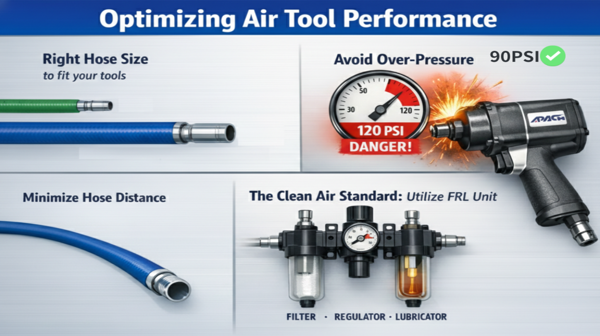
The longer your hose, the more energy is lost before it reaches the tool. If your air compressor is 50 feet away and you’re using a thin hose, your "90 PSI" at the tank might drop to "60 PSI" at the tool the moment you pull the trigger.
Pro Tip: If you need to work far away from the compressor, use a large-diameter rigid pipe (like aluminum or copper) for the long run and save the flexible hose for the last 10–15 feet.
4. The Hidden Danger: Too Much of a Good Thing
While insufficient air leads to poor performance, excessive air pressure is equally dangerous. It’s a common temptation to "crank up" the regulator to 120 or 150 PSI to get more power, but this is a shortcut to tool failure.
Why High Pressure Kills Your Tools:
- Excessive RPM: Air tools are designed to operate at a specific maximum speed (usually around 90 PSI). Over-pressurizing causes the internal turbine or motor to spin at speeds it wasn't engineered to handle, leading to catastrophic bearing failure.
- Mechanical Stress: Think of your impact wrench like an engine. Pushing too much air creates violent internal impacts that can crack the "hammer and anvil" mechanism or shatter internal pins.
- Lubrication Failure: High-velocity air can literally "wash away" the protective oil film inside the tool, leading to metal-on-metal friction and rapid heat buildup.
The Golden Rule: Always check the manufacturer's suggested operating pressure (usually 90 PSI / 6.2 Bar). Using a Filter-Regulator-Lubricator (FRL) unit is the best way to ensure your tool gets "clean, oiled, and correctly pressured" air.
Learn more:
3 Common Mistakes to Avoid When Using an Air Impact Wrench
Maintenance tips for 1” & 3/4” heavy duty impact guns
Optimize Your Air System, Unlock Your Tool’s True Power
If your air tools feel underpowered, the issue may not be the tool itself—but the air system behind it. By choosing the right hose size, upgrading to high-flow fittings, and maintaining proper pressure, you can significantly improve performance without changing your equipment.
At APACH, we design high-performance pneumatic tools engineered to deliver maximum output when paired with the right air system. Whether you're working with 1/2", 3/4", or heavy-duty 1" impact wrenches, having the correct setup makes all the difference.
If you're looking to maximize efficiency, reduce downtime, and get the full power from your tools, feel free to contact us or explore our range of professional pneumatic solutions.