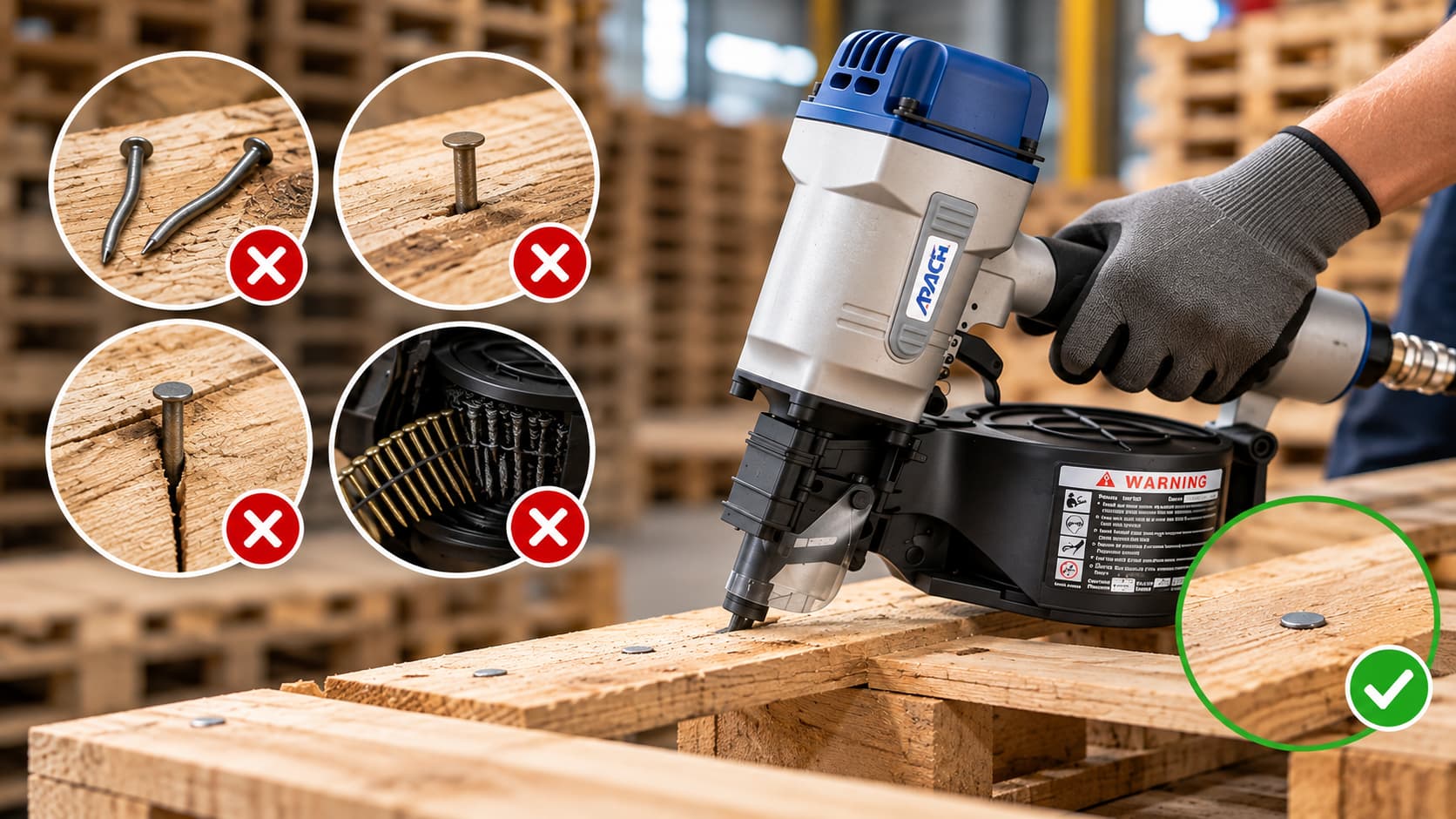
In pallet manufacturing, bent nails, incomplete penetration, wood splitting, and nail jams can lead to wasted fasteners, damaged components, and costly rework. When these problems occur repeatedly during high-volume production, they increase material consumption, interrupt assembly operations, and reduce production efficiency.
APACH Tools, a Taiwan-based manufacturer of pneumatic fastening tools, offers industrial coil nailers for pallet manufacturing, wooden packaging, and crating applications. By selecting compatible fasteners, maintaining stable tool performance, and improving fastening procedures, pallet manufacturers can reduce avoidable defects and improve assembly consistency.
This guide explains the main causes of nail waste, practical ways to prevent rework, and how to evaluate coil nailers for pallet production.
1. What Causes Nail Waste and Rework in Pallet Manufacturing?
Nail waste and rework generally occur when fasteners, wood materials, equipment settings, or operating procedures do not match production requirements.
| Common Problem | Possible Causes | Production Impact |
|---|---|---|
| Bent nails | Hard knots, unsuitable nails, incorrect tool alignment | Wasted nails and repair work |
| Incomplete penetration | Insufficient driving energy, dense wood, restricted airflow | Re-nailing and inspection delays |
| Overdriven nails | Excessive driving energy or incorrect depth setting | Damaged wood and potentially weakened connections |
| Wood splitting | Incorrect nail placement, unsuitable nail diameter, defective wood | Component replacement |
| Nail jams | Damaged nail coils, incompatible fasteners, feeding problems | Production downtime |
| Inconsistent nail placement | Poor alignment or positioning | Assembly defects and rework |
Identifying the specific defect is essential. For example, increasing air pressure may not resolve incomplete penetration if the actual problem is an unsuitable nail specification or excessive wood density.
Key Takeaway: Effective waste reduction begins with identifying the cause of fastening defects rather than repeatedly repairing completed pallets.
2. How Do Nail Specifications and Wood Conditions Affect Fastening Quality?
Fastener selection directly influences pallet assembly quality. Nail length, diameter, shank design, and wood characteristics must be considered together.
Nail Length and Diameter
Nails must provide sufficient penetration into the supporting wood member without protruding or damaging the assembly.
A nail that is too short may not achieve the required connection performance, while an excessively long nail can create protrusion risks. Nail diameter also matters: larger diameters can increase splitting risk under certain conditions, particularly near board edges.
Nail specifications should follow the pallet design and applicable performance requirements rather than a single universal size recommendation.
Smooth, Ring, and Screw Shank Nails
| Nail Type | Characteristics | Selection Consideration |
|---|---|---|
| Smooth shank | Plain shaft, generally easier to drive | Withdrawal resistance may be lower than that of deformed-shank alternatives |
| Ring shank | Annular ridges along the shaft | Can improve withdrawal resistance, depending on wood and fastener design |
| Screw shank | Helical shaft profile | Used where specific withdrawal and connection-performance characteristics are required |
Changing nail types without confirming tool compatibility can introduce feeding problems or inconsistent fastening.
Wood Quality and Moisture Conditions
Wood density, knots, cracks, thickness variations, and moisture content can affect nail driving performance. For example, a fastening setup that works consistently with one batch of softwood may produce incomplete penetration when used with denser material.
Before assembly, manufacturers should inspect wood dimensions and visible defects. Fastening performance should also be checked when material specifications or suppliers change.
Key Takeaway: Correct nail selection must account for both pallet construction and wood conditions. Fasteners should also meet the pallet's applicable design and performance requirements.
3. How Do Air Pressure and Coil Nailer Performance Affect Nail Waste?
Pneumatic coil nailers require an adequate and stable compressed-air supply to drive nails consistently.
When air pressure drops during continuous operation, nails may fail to penetrate fully. Excessive driving energy can cause overdriving and wood damage.
Common causes of inconsistent performance include restricted hoses, air leaks, insufficient compressor capacity, incorrect regulator settings, and worn tool components.
What Should Pallet Manufacturers Check?
- Verify operating pressure against the tool manufacturer's specifications.
- Check pressure stability while the nailer is operating.
- Inspect hoses, fittings, and air connections for restrictions or leaks.
- Confirm that nail length, diameter, and collation match the tool.
- Follow the manufacturer's instructions for cleaning, lubrication, and maintenance.
Never exceed the nailer's rated operating pressure to compensate for poor penetration. If defects continue, inspect the fasteners, wood materials, and tool condition.
Choosing an APACH Coil Nailer for Pallet Manufacturing
APACH offers industrial coil nailers for pallet assembly, packaging, and crating applications. Suitable equipment should be selected according to the required fasteners and production conditions.
| APACH Model | Product Characteristics | Application Consideration |
|---|---|---|
| CN-70.1 Coil Nailer | Supports 45–70 mm nails, 2.3–2.9 mm diameter, with 15° flat-wire collation | Pallet and wooden packaging applications requiring compatible fasteners |
| CN-70E2 Industrial Coil Nailer | Industrial coil nailer with a two-piece nose joint guide | Pallet and crating applications |
| CN-100E Coil Nailer | Industrial coil nailer for larger compatible fasteners | Pallet and packaging applications requiring its supported nail specifications |
Magazine capacity should also be considered for repetitive production. A larger magazine can reduce reloading frequency, but it does not automatically reduce nail defects.
Key Takeaway: The right coil nailer must match the required nails, wood materials, and operating conditions. Stable tool performance is more important than magazine capacity alone.
4. Five Practical Ways to Reduce Nail Waste and Rework
Pallet manufacturers can reduce recurring fastening defects by improving the following five areas.
4.1 Standardize Nail Specifications
Establish approved nail specifications for each pallet design, including length, diameter, shank type, and collation. Clearly identify fasteners at production workstations to prevent operators from loading incorrect nail types.
4.2 Inspect Wood Before Assembly
Check deckboards and supporting members for cracks, unsuitable dimensions, and visible defects. Separating unsuitable components before assembly helps prevent damaged pallets from reaching final inspection.
4.3 Maintain Pneumatic Tools Regularly
Inspect air connections, magazines, and feeding mechanisms according to the manufacturer's maintenance instructions. Remove damaged or malfunctioning nailers from production until they have been inspected.
Always disconnect the compressed-air supply before clearing jams or performing maintenance, following the manufacturer's procedures.
For additional guidance, see APACH's article: Coil Nailer Maintenance Tips: How to Keep Your Tool in Top Shape .
4.4 Improve Nail Placement Consistency
Incorrect nail positioning can contribute to splitting, protruding nails, or connections that do not meet the required fastening pattern.
Use approved nail placement specifications, train operators in correct tool positioning, and consider suitable fixtures for repetitive assembly.
4.5 Record Defects and Corrective Actions
Track bent nails, incomplete penetration, wood splitting, and nail jams by workstation, tool, fastener batch, or pallet model. This helps production teams identify recurring causes and evaluate whether corrective actions are effective.
Key Takeaway: Consistent materials, equipment maintenance, and standardized fastening procedures can help prevent defects before they require rework.
5. How to Measure Nail Waste and Rework in Pallet Production
To evaluate improvement efforts, manufacturers should monitor three practical production indicators.
| KPI | Calculation or Measurement | Purpose |
|---|---|---|
| Nail waste rate | Wasted nails / Total nails consumed × 100% | Measures fastener waste |
| Pallet rework rate | Pallets requiring rework / Total pallets assembled × 100% | Tracks assembly defects |
| Fastening-related downtime | Total time lost to jams, tool problems, and air-supply interruptions | Identifies production disruptions |
For example, if a factory consumes 10,000 nails and discards 300 because of bending, jams, or repairs, its nail waste rate is:
Tracking this figure over time can help determine whether changes in fastener selection, maintenance, or production procedures are reducing waste.
Manufacturers should use consistent measurement methods and compare results under similar production conditions.
6. Frequently Asked Questions About Nail Waste in Pallet Manufacturing
Q1. Should pallet manufacturers use the same nail size for every pallet design?
No. Nail size should be selected according to wood thickness, pallet construction, connection requirements, and applicable performance standards. Different pallet designs may require different fasteners.
Q2. Can a coil nailer drive both ring shank and smooth shank nails?
Some coil nailers support multiple nail configurations, but compatibility depends on the tool's specifications. Manufacturers should confirm nail diameter, length, collation, and other requirements before changing fasteners.
Q3. When should a pallet factory consider replacing its coil nailers?
Replacement may be appropriate when a tool cannot support the required fasteners, no longer performs reliably despite proper maintenance, or does not meet production requirements. Recurring defects should be investigated before assuming that replacement is necessary.
Q4. Can automated nailing reduce pallet assembly defects?
Automated or fixture-assisted nailing can improve positioning repeatability when properly configured. However, fastening quality still depends on suitable fasteners, wood conditions, equipment settings, and maintenance.
Q5. What information should manufacturers provide when selecting a coil nailer?
Useful information includes pallet design, wood type and thickness, nail specifications, available air pressure, production volume, and whether fastening will be performed manually or through an automated system.
7. Conclusion: Improve Pallet Manufacturing by Reducing Fastening Defects
Reducing nail waste and rework in pallet manufacturing requires consistent fastener specifications, suitable wood materials, stable pneumatic-tool performance, and reliable quality control. By addressing recurring defects at their source, manufacturers can reduce unnecessary material consumption and production interruptions.
APACH offers industrial coil nailers for pallet manufacturing and wooden packaging applications. Selecting a compatible model can support more consistent fastening and efficient production.
Looking for a Suitable Coil Nailer for Your Pallet Production Line?
Contact APACH to discuss your nail specifications, pallet materials, and production requirements.